
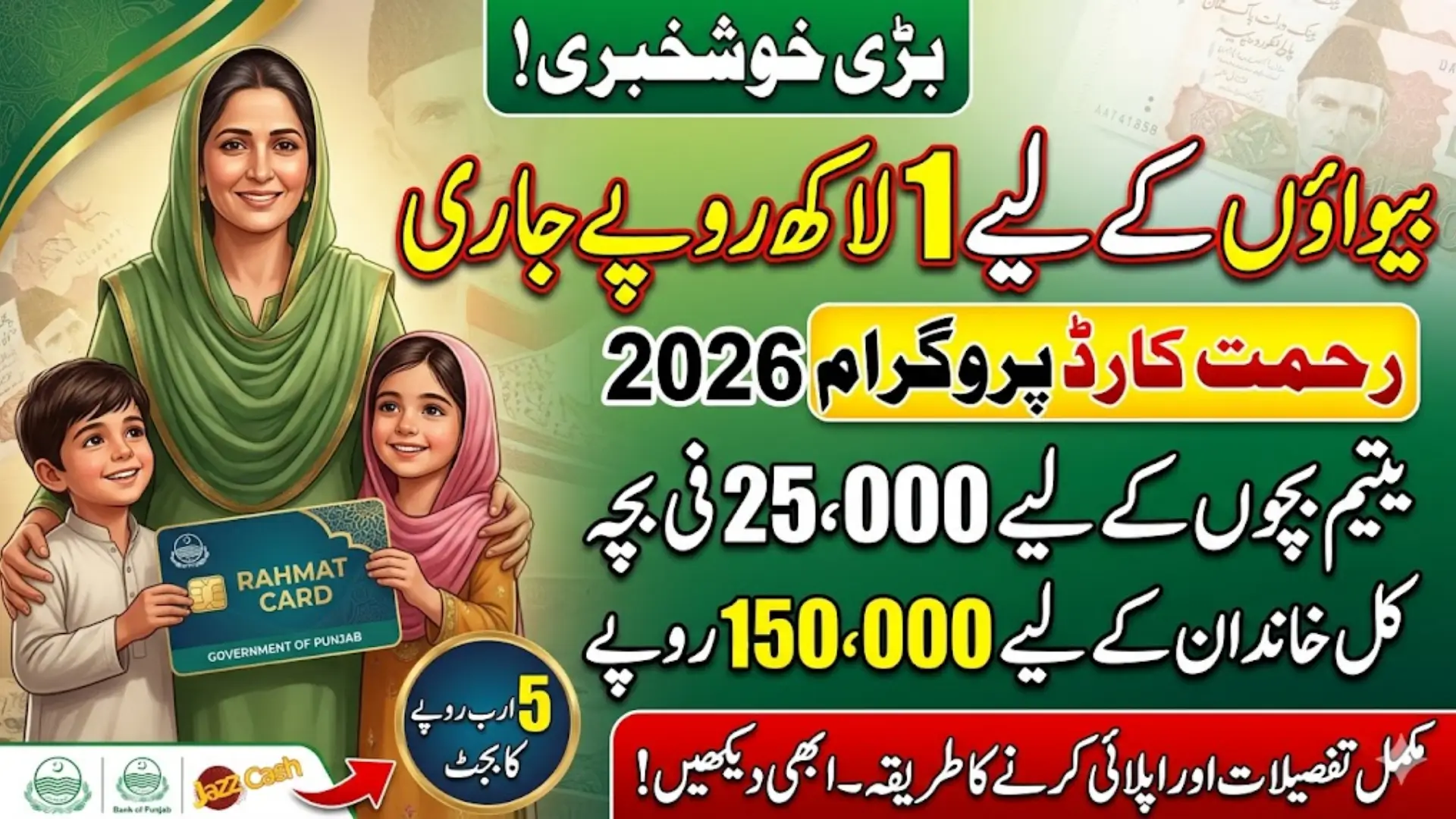
Rahmat Card Program 2026
Rahmat Card Program 2026 Punjab Government has introduced the Rahmat Card Program 2026, a major welfare initiative aimed at providing financial assistance to widows and orphan children across the province. At a time when inflation continues to affect low-income families, this program has been launched to give direct support to households that have lost their primary earning member. With a dedicated budget of Rs 5 billion, the scheme is being described as one of the largest targeted social protection programs introduced for widows in Punjab.
For years, many widow-headed households have struggled to meet daily expenses, arrange education for children, and maintain a stable source of income. Government officials believe that a one-time grant can help such families build a stronger financial foundation rather than relying solely on small periodic payments. The Rahmat Card Program has therefore been designed to provide meaningful financial assistance that can create long-term benefits for deserving families.
The initiative is also important because it introduces a transparent digital system. Instead of manual distribution methods, beneficiaries will receive funds through verified channels after biometric authentication. This approach reduces the chances of fraud and ensures that assistance reaches the intended recipients.
Why the Punjab Government Launched the Rahmat Card Scheme
The main purpose behind launching the Rahmat Card Program is to support families that are among the most vulnerable segments of society. Widows often face financial uncertainty after the death of their husbands, while orphan children frequently encounter challenges in continuing their education and maintaining a decent standard of living.
In many districts of Punjab, especially rural areas, widows have limited access to financial resources and employment opportunities. As a result, they become dependent on relatives or informal support systems. The government believes that direct financial assistance can help these families become more self-reliant and improve their overall quality of life.
The scheme has been designed with several objectives in mind:
- Provide financial support to widows.
- Help orphan children meet educational needs.
- Reduce economic hardships in vulnerable households.
- Promote transparent welfare distribution.
- Improve financial inclusion through digital payments.
- Strengthen Punjab’s social protection network.
- Ensure assistance reaches deserving families without political influence.
Unlike many traditional welfare initiatives, the Rahmat Card Program focuses on creating opportunities for long-term financial stability rather than providing temporary relief alone.
Key Features of Rahmat Card Program 2026
One of the reasons this program has attracted significant public attention is its unique structure. The government has combined financial assistance with modern verification systems to ensure fairness and transparency throughout the process.
The scheme will initially cover 50,000 deserving families in Punjab. Selection will be carried out using official databases and socio-economic information to identify households that genuinely require support. The government aims to expand the program in future phases depending on its success and available resources.
Major features of the scheme include:
- Total budget allocation of Rs 5 billion.
- Financial assistance for widows and orphan children.
- Coverage of 50,000 families during Phase 1.
- Verification through NADRA records.
- Selection based on PSER data.
- Direct payment through Bank of Punjab.
- JazzCash digital wallet payment option.
- Biometric verification before disbursement.
- Dedicated helpline for assistance.
- Transparent and digitally monitored payment system.
These features make the Rahmat Card Program one of the most structured welfare schemes launched in Punjab in recent years.
Rahmat Card Program 2026 Complete Overview
Before applying, families should understand the basic details of the scheme. The following table provides a quick overview of the most important information.
| Feature | Details |
|---|---|
| Program Name | Rahmat Card Program 2026 |
| Launching Authority | Government of Punjab |
| Total Budget | Rs 5 Billion |
| Target Beneficiaries | Widows and Orphans |
| Initial Coverage | 50,000 Families |
| Widow Assistance | Rs 100,000 |
| Per Orphan Child Assistance | Rs 25,000 |
| Maximum Family Grant | Rs 150,000 |
| Verification Method | NADRA and PSER |
| Payment System | Biometric Verification |
| Payment Channels | Bank of Punjab & JazzCash |
| Helpline | 1077 |
Who Is Eligible for the Rahmat Card Program?
Eligibility is one of the most important aspects of the scheme. The government has introduced clear conditions to ensure that assistance reaches deserving households. Instead of relying on recommendations or manual selection, officials will use verified data to determine eligibility.
Families must meet specific requirements before they can become beneficiaries. These conditions have been designed to prioritize households that face genuine financial challenges and fall within the approved welfare criteria.
To qualify for the Rahmat Card Program, applicants generally must:
- Be permanent residents of Punjab.
- Possess a valid CNIC.
- Fall under the Zakat-eligible category.
- Be registered in the Punjab Socio-Economic Registry (PSER).
- Have accurate family information available in government records.
- Complete NADRA verification successfully.
- Belong to a low-income household.
Widows without a stable source of income are among the primary beneficiaries of the scheme. Orphan children who are dependent on their mothers are also included under the program’s support structure.
Financial Assistance Available Under Rahmat Card
The financial package offered under the Rahmat Card Program is considerably larger than many traditional social welfare schemes. Instead of providing small monthly payments, the government has opted for a one-time grant that can help families make meaningful financial decisions.
The assistance structure has been carefully designed to address both immediate and long-term needs. Families can use the funds to invest in income-generating activities, pay school expenses, improve housing conditions, or meet urgent household requirements.
Under the scheme:
- Eligible widow receives Rs 100,000.
- Each orphan child receives Rs 25,000.
- Maximum support per family is Rs 150,000.
- Funds are provided through secure digital channels.
- Payments are verified through biometric authentication.
For many families, this amount can become a starting point for financial recovery and economic independence.
How to Apply for Rahmat Card Program 2026
The government has introduced multiple application methods to make the registration process accessible for both urban and rural residents. Officials understand that not every applicant has access to internet services, which is why several registration options have been provided.
The online portal is expected to be the fastest registration method. However, those who face difficulties can seek assistance through official support channels.
Applicants can register through:
Online Registration
Families can visit the official Rahmat Card portal and submit their details electronically. Applicants must provide accurate household information and CNIC details during registration.
Helpline Assistance
The 1077 helpline has been established to guide applicants through the registration process. Citizens can call this number to receive information regarding eligibility and application status.
District Zakat and Ushr Offices
People who prefer in-person assistance can visit their nearest District Zakat and Ushr Office. Staff members will help applicants complete registration and verification procedures.
The government has encouraged citizens to use only official registration channels and avoid unauthorized agents.
Documents Required for Registration
Many applications face delays because of incomplete documentation. To avoid unnecessary problems, applicants should prepare all required documents before starting the registration process.
Having accurate records available can significantly speed up verification and approval procedures. Officials will cross-check the information with government databases before final approval.
Commonly required documents include:
- Valid CNIC of the widow.
- Husband’s death certificate.
- B-Form of orphan children.
- Registered mobile phone number.
- PSER registration details.
- Household information.
- Supporting records if requested during verification.
Applicants should ensure that all documents are valid and up to date.
How Rahmat Card Payments Will Be Distributed
The payment system is one of the strongest aspects of the Rahmat Card Program. The Punjab Government has chosen digital distribution methods to improve transparency and reduce opportunities for corruption.
Unlike older welfare programs that relied heavily on manual processing, this scheme uses electronic transfers and biometric verification. This helps ensure that every rupee reaches the deserving beneficiary.
Payments will be distributed through:
- Bank of Punjab accounts.
- JazzCash digital wallets.
- Authorized biometric verification centers.
- Secure digital payment channels.
The digital payment model also creates a complete record of every transaction, making monitoring and auditing much easier.
Importance of PSER Registration in Rahmat Card Selection
The Punjab Socio-Economic Registry (PSER) serves as the foundation of the beneficiary selection process. It contains household-level information that helps authorities assess the financial condition of families throughout the province.
By using PSER data, the government can identify deserving households more accurately. This reduces the possibility of favoritism and improves the fairness of welfare distribution.
Benefits of PSER-based selection include:
- Data-driven beneficiary identification.
- Transparent selection process.
- Better targeting of poor households.
- Reduced risk of duplicate applications.
- Faster verification procedures.
- Improved resource allocation.
Families that are not yet part of the PSER database may need to complete registration before becoming eligible for assistance.
How NADRA Verification Ensures Transparency
NADRA verification plays a crucial role in maintaining the integrity of the Rahmat Card Program. Government authorities use official records to verify applicant identities and household information before approving assistance.
This verification process protects public funds and helps prevent fraudulent claims. It also ensures that support reaches genuine beneficiaries rather than ineligible applicants.
NADRA verification helps:
- Confirm applicant identity.
- Verify widow status.
- Validate family records.
- Check children’s information.
- Prevent duplicate entries.
- Reduce fraud and misuse.
The combination of PSER and NADRA verification creates a stronger and more reliable welfare delivery system.
Benefits of Rahmat Card for Widows and Orphan Families
The impact of the Rahmat Card Program extends beyond direct financial assistance. For many families, the grant can become an opportunity to rebuild their lives and secure a better future.
A widow receiving Rs 100,000 can invest in a small business, purchase sewing equipment, buy livestock, or establish another source of income. Additional support for orphan children can help cover educational and household expenses.
Major benefits include:
- Immediate financial relief.
- Increased household stability.
- Better educational opportunities.
- Support for self-employment.
- Greater financial independence.
- Reduced dependence on borrowing.
- Improved living standards.
- Access to formal financial services.
The program is expected to create positive social and economic impacts across Punjab.
How Rahmat Card Is Different From Other Welfare Programs
Punjab already operates several welfare initiatives, but the Rahmat Card Program focuses specifically on widows and orphan children. This targeted approach helps ensure that assistance reaches a group that often remains underserved.
Another major difference is the amount of assistance being offered. The one-time grant is significantly larger than the quarterly payments provided under many other social support programs.
The scheme stands out because of:
- Higher financial assistance.
- Widow-focused support structure.
- Dedicated orphan assistance.
- Digital payment mechanism.
- Biometric verification system.
- Data-based eligibility assessment.
- Transparent monitoring process.
These features make the program unique within Punjab’s social welfare landscape.
Final Thoughts
The Rahmat Card Program 2026 is more than just another financial assistance scheme. It represents a serious effort by the Punjab Government to provide meaningful support to widows and orphan children through a transparent, technology-driven system. With Rs 5 billion allocated for the initiative, thousands of families are expected to receive financial assistance that could significantly improve their living conditions.
By combining PSER data, NADRA verification, biometric authentication, and digital payments, the government has attempted to create a welfare model that prioritizes fairness and accountability. If implemented successfully, the Rahmat Card Program could become a model for future social protection initiatives in Pakistan.
Eligible families should complete their registration as early as possible, ensure their information is accurate, and stay connected with official government channels for updates regarding approvals and payments.